Hello to everyone who has been following this blog for many years - I'm still blogging, I'm just moving over to https://www.claireheffer.com/blog - please continue to follow and let me take this opportunity to thank everyone who has been kind enough to visit over the years. May the lists continue...
Showing posts with label 60s. Show all posts
Sunday, 6 November 2016
Saturday, 5 September 2015
FILM 1375: REGARDING SUSAN SONTAG
REGARDING SUSAN SONTAG is an
intimate and nuanced investigation into the life of one of the most influential
and provocative thinkers of the 20th century. Passionate and gracefully
outspoken throughout her career, Susan Sontag became one of the most important
literary, political and feminist icons of her generation. The documentary
explores Sontag's life through archival materials, accounts from friends,
family, colleagues, and lovers, as well as her own words, as read by Patricia
Clarkson. From her early infatuation with books to her first experience in a
gay bar; from her early marriage to her last lover, REGARDING SUSAN SONTAG is a
fascinating look at a towering cultural critic and writer whose works on
photography, war, illness, and terrorism still resonate today. Written by Question Why
Films
Labels:
60s,
70s,
art,
biography,
book,
documentary,
essay,
family,
feminism,
feminist,
film,
film list,
homosexuality,
movie,
novel,
philosophy,
relationships,
writer
Sunday, 2 August 2015
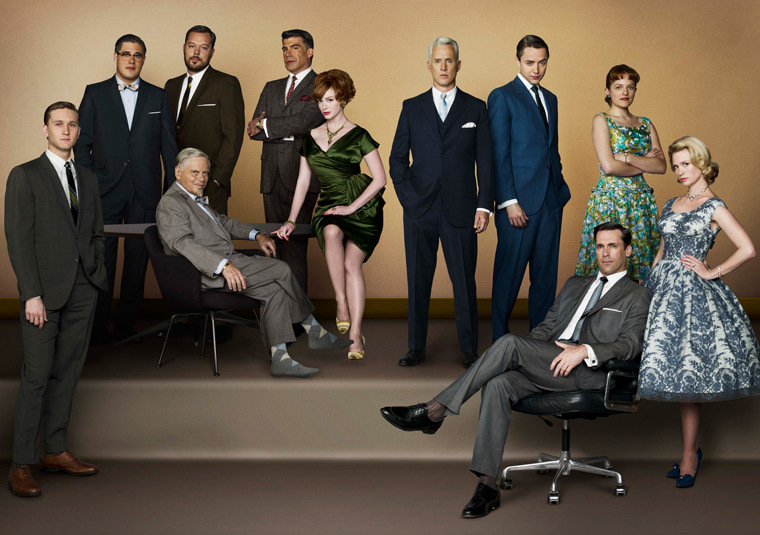
MAD MEN
According to Jon Hamm, the production's
pursuit of historical accuracy is such that series researchers will insist on
knowing weather conditions, news items, and popular culture for a particular
period related to the script's time frame.
The actors do not smoke real cigarettes.
They smoke Ecstacy herbal cigarettes, which are tobacco and nicotine free. Show
creator Matthew Hoffman Weiner
said in a New York Times article, "You don't want actors smoking real
cigarettes. They get agitated and nervous. I've been on sets where people throw
up, they've smoked so much." When asked what it's like to smoke herbal
cigarettes, Jon Hamm
(who plays Don Draper) told Vulture, "Terrible. They taste like a mixture
between pot and soap."
About a year elapsed between the
filming of the pilot, Mad Men:
Smoke Gets in Your Eyes (2007) and the second episode, Mad Men: Ladies Room
(2007).
At a 2013 Q&A session at the
Paley Center for Media, Matthew Weiner said that he had already told his wife
and a few writers about how he plans to end the whole series. He also said that
"he's been told it's a disaster, but he's going with it [anyway]."
Jon Hamm is the only actor to
appear in every episode.
Glen, the neighbor's young son who
forms a connection with Betty, is portrayed by Marten Holden Weiner, the
son of series creator Matthew
Hoffman Weiner.
John Slattery auditioned
for the role of Don Draper before being asked to play Roger Sterling.
In 2012, costume designer Janie Bryant told Slate
magazine that she always repeats one of Peggy's costumes from the previous
season during the next season's premiere. Bryant said that she "[loves]
that tradition for Peggy because I think that this all is really based in
reality. That's what we would do in real life: We repeat our clothes."
On March 23rd, 2015 Jon Hamm released a
statement admitting that he, like his character of Don Draper, had developed an
alcohol addiction, and he had just completed a 30 day rehabilitation.
Julia Ormond, who
guest-stars as Marie Calvet, was such an ardent fan of the show that she once
ended a long-term relationship with someone when he watched a new episode of
Mad Men without her.
The little ball-shaped glasses
often used by Draper and colleagues are a design known since at least the 1950s
as "roly poly" tumblers. The band of metal plating along the rim, an
innovative accent introduced by artist Dorothy Carpenter Thorpe, made the
design even more popular (and much-copied) through the 1960s and beyond. Sets
of these made ideal business gifts, as the bands (made of silver, chrome,
platinum, or even gold) could be custom-stenciled with initials, company logos
or other business-related graphics. Draper's glasses appear to have platinum
bands.
Creator Matthew Weiner directed
every season's finale, all the way up to the series finale.
Labels:
60s,
70s,
advertising,
business,
elizabeth moss,
finale,
john hamm,
madison avenue,
mid century modern,
season,
series,
tv,
weiner
Sunday, 28 June 2015
FILM 1334: HOCKNEY
Randall Wright's documentary film
explores one of Britain's most important artists, David Hockney. With
unprecedented access to the painter and photographer's personal film archive
and incredible work.
Labels:
60s,
art,
artist,
documentary,
fashion,
hockney,
painter,
painting,
perspective
Friday, 15 August 2014
FILM 1191: MAGIC TRIP
TRIVIA: Ken Kesey's original crew
of self-proclaimed "Merry Pranksters" shot about 40 hours of 16-mm
film in an unfinished project. Reportedly, Kesey several times showed all 40
hours - unedited - before he stored the film cans in Eugene, Oregon. They were
rusting away until saved by the documentary directors, who first discovered
they existed in 2004.
Martin Scorsese's film
foundation helped fund the repair of the damaged Kesey footage by technicians
from UCLA, who labored for over a year. Synching up the film to its separate
snippets of audio track proved so daunting that director Alison Ellwood resorted to
hiring a lip reader to determine what words people were mouthing.
Merry Prankster Neal Cassady was the
real-life model for character Dean Moriarty in Jack Kerouac's 'On the
Road' novel.
Labels:
60s,
acid,
art,
bus,
characters,
documentary,
drugs,
film,
film list,
filmlist,
merry pranksters,
trip,
writer
Monday, 11 August 2014
FILM 1182: HARAKIRI
TRIVIA: While filming, Tatsuya Nakadai was afraid
during most of the sword and spear fighting scenes because real swords were
being used, a practice now forbidden in Japanese films. His concern was not
alleviated even though professional swordsmen were employed during the
choreographed swordplay.
Seppuku and harakiri (the US
working title) both mean to commit ritual suicide in Japanese. However, seppuku
is the formal term, derived from the kanji characters for "hara"
(belly) and "kiri" (cut); harakiri is the cruder, less polite term
for this act.
Subscribe to:
Posts (Atom)